

How to Measure Bike Handlebar Sizes Correctly
Before replacing the new carbon fiber handlebars or fine-tuning the bicycle configuration. It is crucial to know the specific size of the bicycle handlebars. This is not only related to the width, diameter, or forward and backward extension of the handlebars. But also directly affects the compatibility of the handlebars, the handling of the bicycle. The comfort of riding and other related issues. Whether you are cycling on the road or mountain, this article will teach you how to Measure Bike Handlebar Sizes Correctly. And how to better control your bicycle and improve your riding experience by obtaining the correct handlebar size. This guide will teach you one by one how to measure quickly to ensure its accuracy.
Understanding Bike Handlebar Sizes
Before you choose the carbon fiber Bike Handlebar that suits you. We first need to understand exactly what parameters the term “Bike Handlebar Sizes” includes. The relevant dimensions of these parameters not only directly affect whether the handlebars can be installed well. But also directly influence the handling performance and our riding posture, etc.
What is the handlebar size?
Handlebar size is generally just a comprehensive concept, mainly including the following key physical parameters:
1. Bike Handlebar Diameter
The diameter of a bicycle handlebar refers to the diameter of the circular part of the handlebar. which is the distance from the outer edge of one side to the outer edge of the other side, usually measured in millimeters. It is directly related to the location matching and placement relationship of the Stem or other Bike Accessories. We only need to focus on the two types of diameters, Clamp Diameter and Grip Diameter. Below, I will introduce their differences to you:
Clamp Diameter (Diameter of the installation clamping area), this is the position where the middle part of the bicycle handlebar is fixed on the Stem of the frame. and the commonly used specifications are 25.4mm, 31.8mm, and 35mm.
- 25.4mm: Old mountain bikes and some city bikes
- 31.8mm: Modern standard, used by both mainstream mountain bikes and road bikes
- 35mm: More robust, suitable for high-intensity mountain biking (Enduro/DH)
Grip Diameter (diameter of the holding area): This is the thickness of the part you hold in your hand. which will directly affect your hand feel and the installation of accessories. We generally divide it into two sizes: 22.2mm and 23.8mm. But, smaller sizes are used in mountain bikes and city commuter vehicles. The diameter of 23.8mm is often used for curved bicycle handlebars (for installing handlebars).
2. Bike Handlebar Width
The width of the handlebars refers to the lateral distance from one end to the other of a bicycle handlebar. Usually measured in centimeters or millimeters. The measurement method of Bike Handlebar Width is the distance from the end of one side of the handlebar to the end of the other side. It can also be the measured distance between outer edges and outer edges, or between inner edges and inner edges.
The width of the handlebars of a general road bicycle is between 36 and 44cm. The narrower handlebars of this type help reduce wind resistance and improve the efficiency of high-speed cruising. Mountain bikes have a width ranging from 680 to 880mm, or even wider. Wider handlebars can better enhance control, making them more suitable for technical off-road riding. The bicycles are for leisure commuting, but depend on the two and their purpose.
3. Reach (forward extension) and Drop (downward Drop) – For Drop Bars
The two parameters, Reach and Drop, mainly appear on the handlebars of road bikes. and are important parameters that directly affect the switching of your riding posture and the aerodynamic effect.
Reach: Mainly the horizontal distance from the center clamping point to the front of the top of the hand-held curved handle. It determines your riding posture. If you want a more aggressive posture, then you need a longer Reach.
Drop: It refers to the vertical height distance from the top of the handle to the bottom of the downbend. It generally determines your body’s center of gravity and wind resistance control ability when you switch to the lower grip position. This Drop value is between 120 and 140mm, and this distance range belongs to deep bend handles. There are also comfortable versions with short reach & shallow drop (such as 100mm).
The handlebar sizes of different types of bicycles vary
Different types of bicycles have obvious differences in the design of handlebars. So, before choosing handlebars, we should first determine our riding style and purpose. The handlebars and sizes of the following types of bicycles will vary.
Road Bike: This type of bicycle usually uses a Drop Bar. What we mainly focus on is the matching degree between the handlebars and the shoulder width, Reach & Drop, and Clamp Diameter. The common size is generally 31.8mm.
MTB Bike: This type of bike is mainly equipped with a Flat Bar and a Riser Bar. There are three main dimensions of concern. Generally, the handlebars of mountain bikes are relatively wide (680-800mm). followed by the Clamp Diameter (31.8 or 35mm), and the grip diameter is 22.2mm.
City/Hybrid Bike: Generally, it is mainly a Comfort Bar or Cruiser Bar. The handlebars of this type of bike are flexible in size, but generally focus on comfort. The width is medium, but its raising Angle is relatively large.
Related Articles: Best Bike Handlebar Types for Every Riding Style.
Measure Bike Handlebar Sizes: Step-by-Step Guide
The following are several important dimensions of bicycle handlebars are the ranges we need to know about for measurement. Below, I will show you the step-by-step guide on how to Measure Bike Handlebar Sizes.
Tools You Need to Measure

To accurately understand the bike handlebar sizes, you need some simple but precise measurement tools:
- Tape Measure:
- The main purpose is to measure the total width of the bicycle handlebars. But, for the measurement of curved handlebar curves that need to fit, it is recommended to use a flexible ruler or a flexible tape measure.
- Caliper:
- It is mainly used to measure the diameter of the handlebars, including the Clamp Area and the Grip Area. But, the Digital Caliper is recommended here because this type of digital caliper has high accuracy, and the unit can be switched to (mm/inch).
- Steel ruler/standard ruler:
- This type of ruler is mainly used to measure the Drop Bar of road bikes. When measuring Reach and Drop, it is necessary to maintain a horizontal reference. Just use a simple aluminum level or a mini level with bubbles
- White calipers and marker pens.
How to Measure Bike Handlebar Width
Below, I will provide examples for measuring the width of the Drop Bar of a road bike and the flat handlebars of a mountain bike. Please read on.
Step for Measuring the Width of Road Bike Handlebars (Drop Bar)
For the Drop Bar, we adopt the Center-to-Center measurement method.
- First, secure your bicycle to the frame or place it steadily against the wall.
- Please confirm the handlebars’ outermost downward bend (Drop area) and measure the straight-line distance from the center point on both sides below to the center point.
- At this point, you need to use a flexible ruler or a straight ruler to measure from the center point of the left handle to the center point of the right handle, and then record the regular dimensions, as shown in the figure.

Steps for measuring the width of a mountain bike handlebar (Flat/Riser Bar)
- Fix the vehicle body with brackets and place it on level ground.
- Then find the outermost edge of both ends of the handlebars, that is, the end of the handlebars.
- Then, use a tape measure or a ruler to move from the outer edge of the left handle end to the outer edge of the right handle end. In millimeters, and record the size range.

Typical Handlebar Width Ranges: Road vs Mountain vs Hybrid Bikes
| Bike Type | Common Width Range |
|---|---|
| Road Bike (Drop Bar) | 36 cm – 44 cm |
| Mountain Bike (Flat/Riser Bar) | 680 mm – 800 mm |
| City/Hybrid Bike | 580 mm – 700 mm |
How to Measure Handlebar Diameter
There are several methods to measure the diameter of the handlebars. But the key areas we need to measure are the diameter of the clamping area and the diameter of the grip area.
- The diameter of the clamping area – the position where the rod clamps the handlebar (the most crucial).
- Grip area diameter – The place where the grip is held or where the grip, lever, and accessories are installed.
Method 1: Use a digital caliper.

First, determine the clamping area for measurement, that is, the central area close to the handlebar. Directly open the jaws of the caliper and gently place the digital caliper in the central clamping area for measurement.
- Common fixture diameters: 25.4mm, 31.8mm, or 35mm.
- The handle area of the flat handle is usually 22.2 millimeters, and that of the curved handle is usually 23.8 millimeters.
Method 2: Use a soft tape measure.
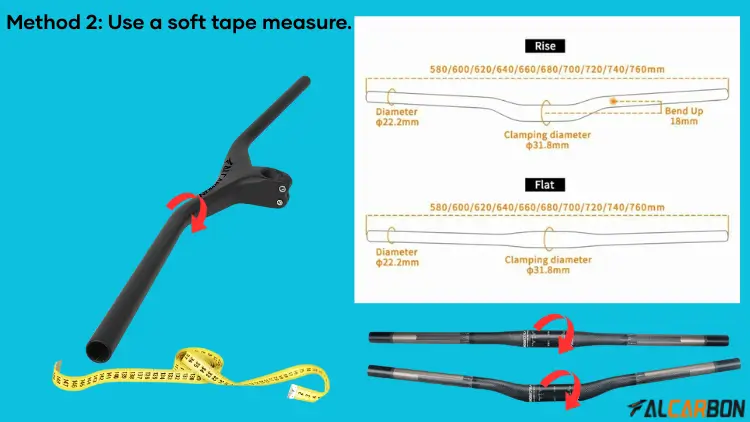
Use a soft tape measure to measure along the circumference of the handlebars.
Then use the formula: Diameter = Circumference ÷ π (~3.14). For example: Perimeter = 99.9 millimeters → Diameter = 99.9 ÷ 3.14 ≈ 31.8 millimeters.
Method 3: Steel ruler/standard ruler + Paper (and pen).
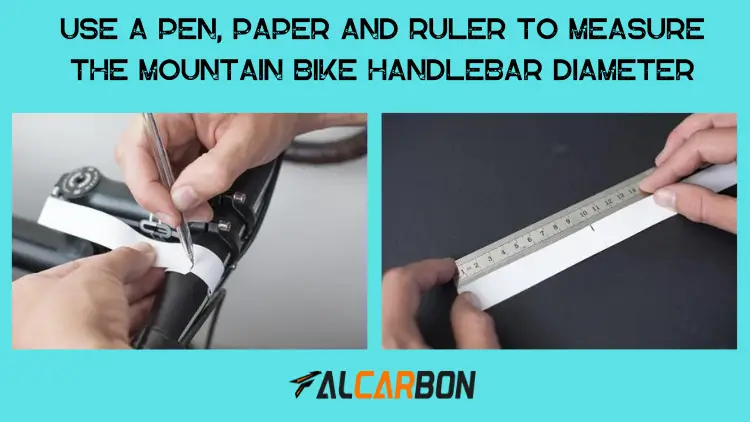
Another method is you use a thin piece of paper. Wrap it around the center of the handlebar, and mark the circumference of one circle with a marker pen. Then take the paper off and measure its length with a steel ruler. The algorithm calculates the diameter range based on the perimeter as in Method Two.
Measuring Reach and Drop (for Drop Bars)
The general handlebars are usually used in road bicycles and mainly take into account artificial stereography. But, the two most important parameters of the curved handle shape are: Reach and Drop. Next, I will introduce it and the related measurement methods one by one.
Reach: It is the horizontal distance from the center of the handlebar holding area to the center of the very front of the handlebar (usually the starting point of a curve or the area where the hood is installed).

- First, place the handlebars on a flat surface.
- Then use a ruler or tape measure to measure the center of the fixture area and the center point at the very front of the curve. and measure the horizontal distance between these two points. The common extension range is approximately 70 to 90mm.
Drop: It is the vertical distance from the top of the pole (the flat part beside the pole body) to the lowest part of the curved drop.

- Before the measurement, you need to place the handlebars on a horizontal surface.
- Then place a level or caliper on the flat top part of the rod.
- Then measure the vertical distance from this horizontal line to the center of the bottom of the water droplet. The common drop range is generally around 120 to 140 millimeters.
How to choose a bike handlebar size?
Choosing the right handlebar size for a bicycle is not only determined by the numbers. But we also need to consider the rider’s body size, riding style, and comfort preferences, etc. To find the most suitable size.
1. Choose the appropriate handlebar size for your bicycle based on your body type.
We need to match the width of the handlebars with the width of the shoulders, especially for road bikes.
- For road bikes, the width of the handlebars is generally equal to or slightly narrower than the shoulder width (measured from the AC joint to the AC joint).
- Narrow shoulders → Narrower barbells (for example, 36-38 centimeters)
Consider your cycling style
Different riding styles require different handlebar widths and characteristics. Please refer to the following table for selection:
| Riding Style | Recommended Width | Reason / Features |
|---|---|---|
| Racing / Road Sport | Equal to or slightly less than shoulder width | Improves aerodynamics and reduces drag |
| Long-distance Touring | Same as shoulder width | Offers stable and comfortable positioning |
| Mountain Biking (MTB) | Wider bars (720mm and above) | Enhances steering control and downhill stability |
| Urban / Commuting | Moderate width (680–720mm) | Balances maneuverability in tight spaces and comfort |
Shoulder Width vs Handlebar Width
The following table can help you match your forehead and shoulder width and height with the width of your road bike and mountain bike that suits you. Please check the table.
| Shoulder Width (cm) | Recommended Road Bar Width (cm) | Recommended MTB Bar Width (mm) |
|---|---|---|
| < 36 cm | 36 cm | 680–700 mm |
| 36–40 cm | 38–40 cm | 700–740 mm |
| 40–44 cm | 42 cm | 740–780 mm |
| > 44 cm | 44 cm+ | 780–800+ mm |
Warm reminder from Falcarbon Bicycle:
We do not recommend that you use handlebars that are too wide or too narrow, as this may not only cause strains in your shoulders, wrists, or back, etc. For the curved handle, we need to consider its width and shape.
Related Articles:
- Top 8 Best MTB Grips for All-Terrain Riders
- How to Measure Bike Stem Length
- How to remove bike handlebar grips
- How to Measure MTB Saddle Size
FAQ
How do I tell what size my handlebars are?
To determine the size of a bicycle handlebar, first measure the width, then the diameter. If it is a curved handlebar, the forward and backward extensions also need to be measured.
What is the internal diameter of a 7 8 handlebar?
The inner diameter of 7/8-inch handlebars is approximately 22.2 millimeters, usually ranging from 18 to 19 millimeters, depending on the wall thickness of the handlebar tubes. If you are installing handlebar end accessories such as rearview mirrors, handlebar plugs or handlebar gear levers, it is very important to measure the inner diameter. To obtain an accurate inner diameter, please use a digital caliper to measure the length from the inner edge to the inner edge.
How do you measure handlebar width for cycling?
Flat handlebars are typically measured from end to end, while drop bars (road handlebars) are measured from the center of one brake hood to the center of the other. Road bike handlebar widths usually range from 38 cm to 46 cm, whereas mountain bike handlebars are generally wider, ranging from 68 cm to 82 cm.
How to measure handlebar grip size?
To measure your handlebar grip size, start by determining the diameter of the grip area on the handlebar, which is where your hands rest. Use a digital caliper to measure the outside diameter of the handlebar tubing in this section—most standard bars have a grip diameter of 22.2mm for flat or riser bars. If you’re replacing grips, also measure the length of the current grips from end to end to ensure a proper fit, especially if you use accessories like bar ends or shifters.
Conclusion
Through the above guide description, we believe you have gained a quick understanding of how to Measure Bike Handlebar Sizes Correctly. Because the precise handlebar size is not merely a technical detail. it directly affects your riding experience, riding posture, and handling. It is important to understand every detail of how to quickly measure the size of a bicycle handlebar. from the diameter of the handlebar clamp to the width of the handlebar, and even the drop and forward extension of road bikes. Then you can choose a handlebar that truly suits your style and body shape. Follow the operation steps and quickly find a bicycle handlebar size that suits you to make your riding experience more pleasant.


